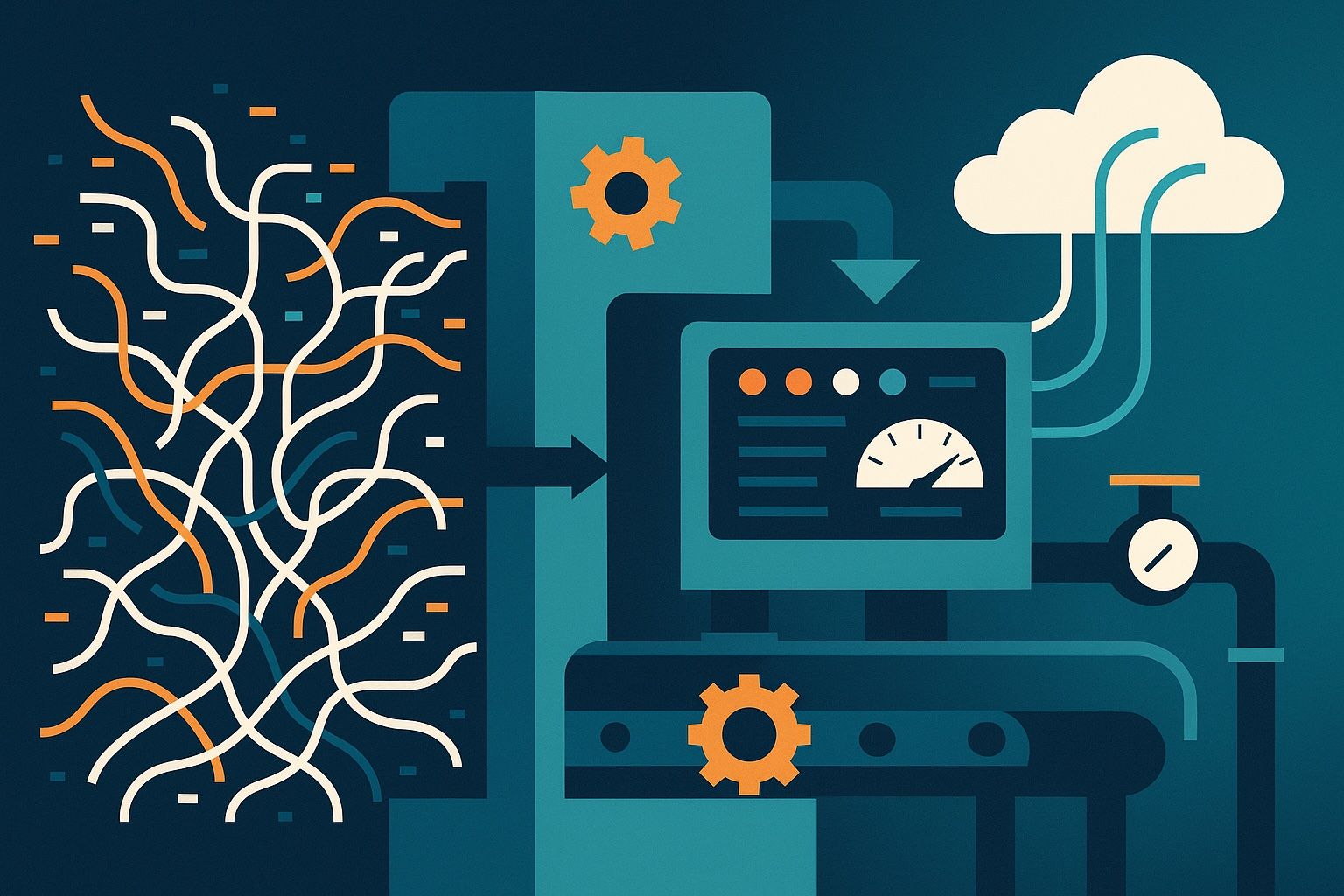
Every modernization begins with optimism and ends with improvisation. What if modernization could be engineered to behave predictably?
The Pattern Every CTO Recognizes
Every modernization story starts the same way.
A room full of architects and deadlines.
A plan that looks certain on paper.
Then — weeks later — the first exceptions appear.
Stored procedures that won’t compile.
Queries behaving differently in the cloud.
Timelines stretch, budgets bleed, and “cutover weekend” starts to sound like folklore.
It’s not incompetence. It’s entropy.
The larger the system, the more invisible logic it carries — and the harder it becomes to move with certainty.
Modernization today still runs on heroics: clever engineers, late-night fixes, untraceable scripts.
It works, but only once. And never the same way twice.
That’s not modernization. That’s craftsmanship.
And craftsmanship doesn’t scale.
From Heroic Craft to Engineered Precision
Every industry goes through the same evolution.
At first, progress depends on artisans — talented individuals who shape outcomes by intuition.
Then, one day, the scale breaks them.
Quality becomes unpredictable. Costs become nonlinear.
And the only way forward is industrialization.
Manufacturing had its assembly line moment a century ago.
Modernization is having it now.
At SmartMigrate, we call it the Factory Model for Data Modernization — a system that transforms modernization from a bespoke project into an engineered process.
Instead of relying on people to remember every dependency, every nuance, every test case, SmartMigrate structures modernization as a closed-loop production system:
Each phase feeds the next, each output is measured, and each failure is caught before it multiplies.
Modernization becomes less about effort — and more about design.
Phase One — Extract: Building the Ground Truth
Every system has a memory.
Before you can change it, you have to understand it.
SmartExtract starts there — pulling metadata, code, and lineage from every corner of your legacy landscape: Teradata, Oracle, SQL Server, DB2, Hive, Netezza, PySpark, and more.
It doesn’t just “export” schemas; it documents behavior — stored procedures, query patterns, object dependencies, and even usage statistics from execution logs.
By the time SmartExtract finishes, you’re not staring at a database — you’re holding a digital twin of your data estate, packaged in standardized manifests with checksums and traceable lineage.
Imagine it as the raw material entering the production line — structured, clean, and verified.
A modernization factory can’t run on assumptions; it needs truth as input.
Phase Two — Discover: Turning Complexity into Clarity
Once the truth is in hand, the next question emerges: what do we move first?
In traditional projects, this answer lives in slide decks and instinct.
In SmartDiscover, it lives in data.
SmartDiscover transforms the extracted estate into a migration blueprint — scoring every object by complexity, risk, and dependency.
Stored procedures become nodes in a dependency graph; anti-patterns are flagged automatically; risk registers are generated with evidence, not anecdotes.
What used to take weeks of “impact analysis” becomes a visual, queryable map of your modernization journey.
This is the first visible proof of control.
You’re no longer estimating effort — you’re engineering it.
Phase Three — Convert: The Assembly Line for Code Modernization
In every factory, the assembly line is where transformation happens.
For modernization, that line is SmartConvert.
Here, legacy SQL, procedural code, and DDLs are translated into modern dialects with machine precision — and human oversight exactly where it matters.
SmartConvert combines rule-based mapping with LLM-assisted guidance, ensuring every stored procedure, query, and script not only converts syntactically, but also semantically.
It’s not “AI magic.”
It’s controlled automation — deterministic where possible, intelligent where required.
Each translation passes through validation gates: syntax checks, semantic verification, catalog cross-checks, and optional dry runs.
Every potential issue is tagged as a review marker so human experts focus only on exceptions, not the 95% that runs clean.
In our proof-of-concept programs, this model achieved:
- 95% automated conversion rate
- 90% reduction in manual coding
- 50–70% faster cutovers
- 99.5% syntactic compatibility before user testing
That’s not incremental improvement — that’s industrial acceleration.
Phase Four — Reconcile: Closing the Loop of Trust
Factories end where confidence begins — inspection.
In modernization, that inspection is SmartReconcile.
It runs comprehensive verification between legacy and target systems:
row counts, schema alignment, query results, and policy checks.
Think of it as the QA department of modernization — the gate that certifies correctness before release.
When SmartReconcile runs, it doesn’t ask for trust — it produces evidence.
Every validation cycle generates an auditable report, with parity results, exceptions, and performance insights.
This isn’t “hope-based migration.”
It’s modernization with a signature.
The Economics of Predictability
Speed is a byproduct of control.
By standardizing every stage of modernization, SmartMigrate doesn’t just automate — it stabilizes.
Errors don’t cascade downstream. Effort doesn’t multiply. Timelines don’t slip.
The results speak the language of CFOs and engineers alike:
- 60% fewer manual review cycles.
- 50–70% faster delivery.
- 90% less rework effort.
Predictability isn’t about perfection.
It’s about governed momentum — knowing that every hour spent moves the system forward, not sideways.
When you industrialize modernization, you change its economics.
Every project after the first one becomes easier, faster, more reliable — because the system learns.
Factories don’t start over for every batch.
Neither should modernization.
The Future: From Projects to Programs
Modernization has always been reactive — driven by deadlines, not design.
But the organizations winning in this decade are those who build modernization as infrastructure, not as an initiative.
SmartMigrate embodies that shift — from craft to control, from manual to measured, from projects to programs.
Each phase isn’t just a feature; it’s a feedback loop.
SmartExtract informs Discover. Discover calibrates Convert. Convert feeds Reconcile.
And Reconcile produces the telemetry that improves the next cycle.
That’s how modernization becomes self-improving — a continuous process rather than a recurring disruption.
We call this The Architecture of Certainty:
a way to modernize not by willpower, but by system design.