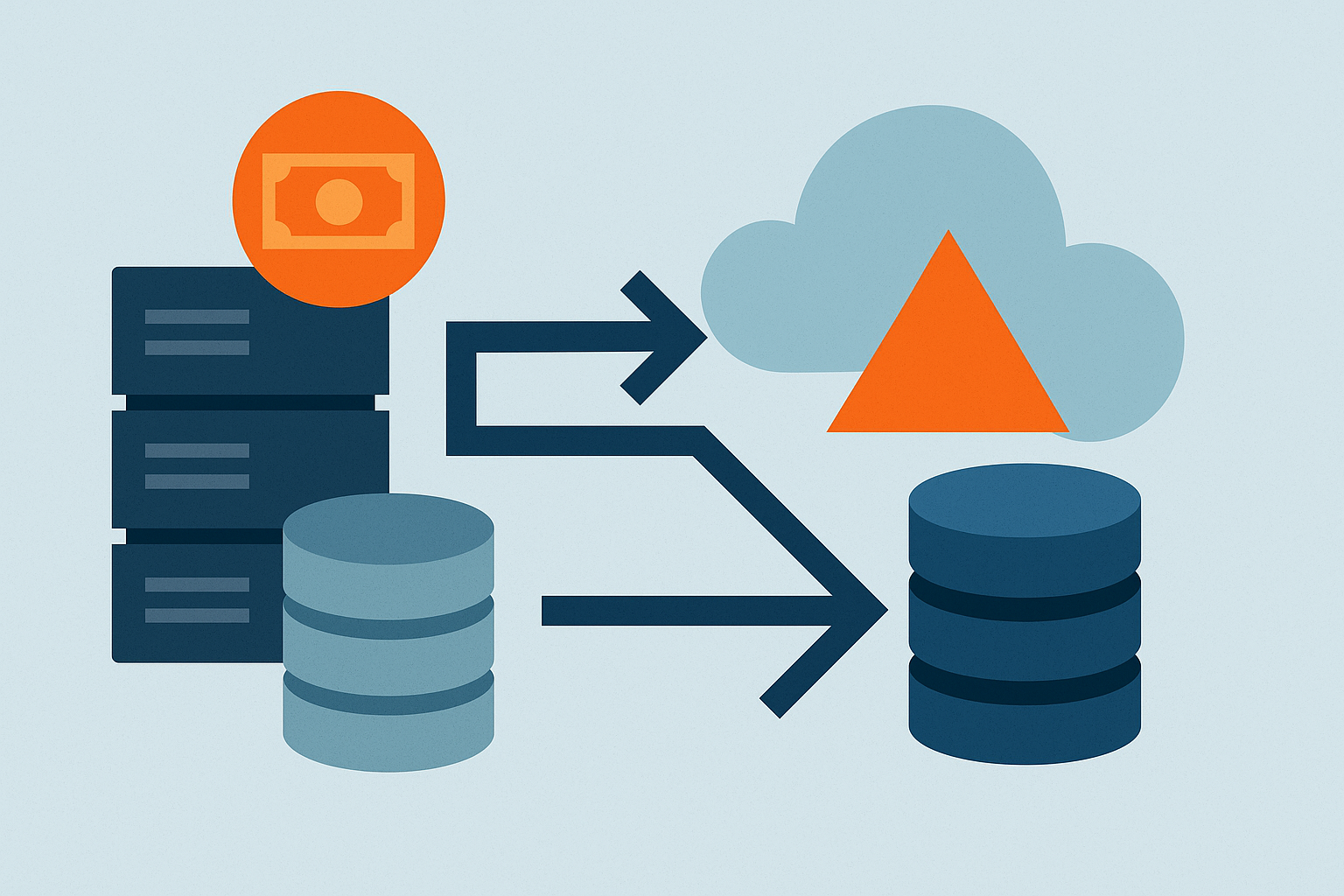
Moving your workloads to the cloud isn’t modernization.“lift and shift” migrations replicate data debt, delay innovation — learn how to avoid it.
When it comes to cloud migration, speed without structure is expensive. “Lift and shift” promises quick results — but often leaves you with the same inefficiencies, technical debt, and data blind spots, just hosted somewhere else.
1. The Mirage of “Fast” Migrations
It sounds efficient: take what you have, move it to the cloud, and call it modernization. But while the servers move, the problems don’t.
Most “lift and shift” migrations simply relocate legacy workloads. The SQL, procedural logic, and brittle data pipelines remain unchanged — only the invoice changes.
What looks like a fast migration often becomes a slow reinvention of the same system in a new environment, complete with higher costs and lower visibility.
2. The Hidden Cost of Data Debt in the Cloud
Every legacy system carries data debt — accumulated complexity in stored procedures, embedded SQL, and undocumented dependencies. When you “lift and shift,” that debt doesn’t disappear; it compounds.
Cloud-native databases have different dialects, optimizers, and performance semantics. Procedures written for on-prem engines behave differently in BigQuery, Snowflake, or Databricks. Manual fixes and refactoring become inevitable.
You’ve essentially paid to re-host your debt — and now it accrues interest in the form of operational overhead, cost inefficiency, and untraceable lineage.
3. What “Lift and Shift” Really Solves — and What It Doesn’t
✅ What It Solves
❌ What It Doesn’t
Hardware refresh
Legacy logic and schema design
Short-term infra scalability
Procedural sprawl and code debt
Data center costs
Complexity, validation, and risk
Hosting agility
Predictability and modernization outcomes
A direct replatform might buy you time, but it doesn’t buy you certainty. If your goal is transformation — not just relocation — you need to rebuild visibility, validation, and control.
4. Why True Modernization Requires Discovery
Modernization isn’t about moving faster — it’s about knowing what you’re moving. That starts with automated discovery.
SmartMigrate’s SmartExtract and SmartDiscover phases address the root cause of migration failure: missing context.
- SmartExtract standardizes all your metadata, stored procedures, queries, and workloads into a unified manifest.
- SmartDiscover scores complexity, maps dependencies, and outputs a migration blueprint that shows what’s safe to automate and what needs expert oversight.
Without that visibility, “lift and shift” is a leap of faith — and faith is not a migration strategy.
5. The Problem with Partial Automation
A new wave of “AI-powered migration tools” claim to fix code automatically. While these tools can assist, automation without guardrails is just as risky as manual rewrites.
True modernization requires a factory model that combines automation and validation:
- Multi-file orchestration and dependency sequencing
- Syntax and semantics validation against target catalogs
- LLM-assisted refactoring with rule-anchored mappings
- Review markers and quality gates for human oversight
SmartMigrate’s SmartConvert phase achieves exactly that — translating logic with precision, enforcing governance, and cutting rework by up to 90 %.
6. Modernization as a Strategic Dividend
The goal of modernization isn’t to move faster — it’s to move smarter. A structured modernization approach yields measurable dividends:
- 50–70 % faster cutover via automation and playbooks
- 60 % reduction in manual review cycles
- 99.5 % syntactic compatibility pre-UAT for supported patterns
- Audit-ready controls that meet enterprise governance standards
Modernization done right doesn’t just migrate workloads — it liberates your data team to innovate, experiment, and optimize in the new environment.
7. The SmartMigrate Framework: Modernize with Certainty
Every SmartMigrate engagement follows the same engineered flow:
- Extract — Pull and manifest all logic, metadata, and query history.
- Discover — Score complexity, dependencies, and risk.
- Convert — Translate, validate, and optimize across dialects.
- Reconcile — Verify outputs, performance, and data parity.
Each phase is expert-operated, automation-anchored, and audit-ready — ensuring that modernization is a controlled process, not a leap of faith.
This approach doesn’t just prevent more data debt — it turns the migration into a strategic dividend your organization can reinvest in innovation.
8. The Takeaway: Don’t Just Move — Modernize
A “lift and shift” project gives the illusion of progress while preserving the very inefficiencies that held you back. A modernization-first approach replaces that illusion with predictability.
If you’re planning your next migration, start with discovery — not deployment. Map your logic. Score your complexity. Validate your future before you move