DATE vs TIMESTAMP drift
Oracle DATE includes time; conversions that assume date-only semantics shift buckets and KPIs
Migration
Move Oracle DW/OLAP workloads (schemas, PL/SQL, ETL jobs, and BI-dependent SQL) to BigQuery with predictable conversion and verified parity. SmartMigrate makes semantic and performance differences explicit, produces reconciliation evidence you can sign off on, and gates cutover with rollback-ready criteria—so production outcomes are backed by proof, not optimism
Quick answer
Move Oracle DW/OLAP workloads (schemas, PL/SQL, ETL jobs, and BI-dependent SQL) to BigQuery with predictable conversion and verified parity. SmartMigrate makes semantic and performance differences explicit, produces reconciliation evidence you can sign off on, and gates cutover with rollback-ready criteria—so production outcomes are backed by proof, not optimism
Shared migration method
These canonical guides explain the repeatable method. The pair-specific sections below cover the platform constraints that change the migration decision.
Fit
Risk map
These are the common “gotchas” that cause silent KPI drift, BI breakage, operational failures, or cost surprises if not handled explicitly
| Breakage | Mitigation |
|---|---|
| Data type and time semantics drift (DATE/TIMESTAMP, time zones, NUMBER precision)Oracle DATE carries time, TIMESTAMP precision and time zone behavior vary, and NUMBER-to-BIGNUMERIC mapping choices matter. Without explicit casting rules, aggregates and joins can change silently | Mitigation: Assess, rewrite where needed, then validate with parity checks. |
| Implicit conversion and NLS/session settings don’t exist in BigQueryOracle often relies on implicit casts and NLS parameters (date formats, collation, numeric characters). BigQuery requires explicit, deterministic parsing—otherwise pipelines fail or results drift | Mitigation: Assess, rewrite where needed, then validate with parity checks. |
| PL/SQL business logic cannot be “auto-translated” end-to-endPackages, procedures, functions, exception handling, and cursor logic need re-homing (SQL rewrite, Dataform/dbt macros, or service-layer code). Deferring this creates post-cutover production gaps | Mitigation: Assess, rewrite where needed, then validate with parity checks. |
| ETL tool semantics and scheduling glue break during re-platformingInformatica/ADF jobs often encode Oracle-specific assumptions (merge patterns, transaction semantics, staging conventions). You need an execution plan for orchestration and idempotency—not just SQL conversion | Mitigation: Assess, rewrite where needed, then validate with parity checks. |
| BI/reporting coupling is usually the real riskDashboards often depend on undocumented behaviors: rounding, ordering, NULL treatment, time bucketing, and ‘default’ filters. If you don’t lock a parity contract, correctness becomes a debate at cutover | Mitigation: Assess, rewrite where needed, then validate with parity checks. |
| Performance model shift: indexes/optimizer vs partitioning + scan economicsOracle tuning leans on indexes, statistics, and optimizer behavior. BigQuery performance depends on partitioning, clustering, join strategy, materialization, and concurrency/slot planning | Mitigation: Assess, rewrite where needed, then validate with parity checks. |
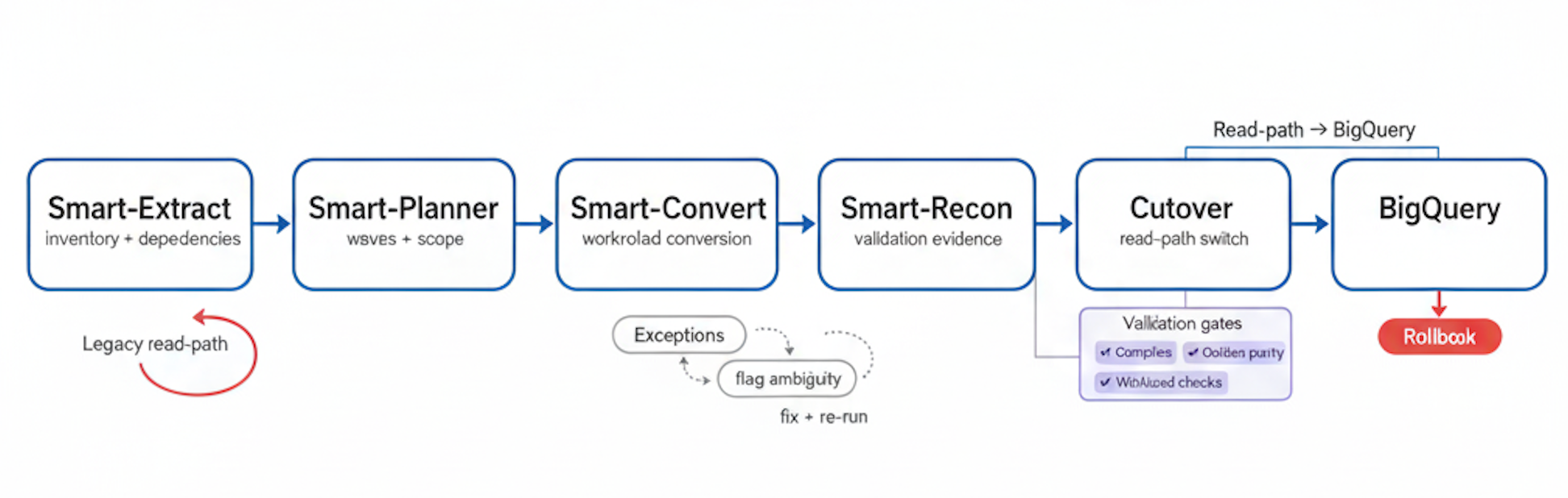
Flow
Extract → Plan → Convert → Reconcile → Cutover to BigQuery, with exception handling, validation gates, and a rollback path
Conversion
Oracle → BigQuery migration is not just “SQL translation. The objective is to preserve business meaning while aligning to BigQuery’s execution model and cost structure. SmartMigrate converts what is deterministic, flags ambiguity, and structures the remaining work so engineering teams can resolve exceptions quickly." What we automate vs. what we flag:
Failure modes
Oracle DATE includes time; conversions that assume date-only semantics shift buckets and KPIs
NUMBER-to-NUMERIC/BIGNUMERIC choices change rounding and equality behavior, breaking joins and aggregates
Pipelines rely on session formats and implicit conversions; BigQuery requires explicit parsing and typing
Procedures/packages are left for “phase 2,” and operational workloads break immediately after cutover
Oracle merge/upsert patterns don’t re-home cleanly; backfills become slow or non-idempotent
Concurrency and workload bursts aren’t planned; BigQuery slots/reservations and materialization aren’t set, causing latency and cost spikes
Multi-hop staging workflows are ported as-is, increasing latency and failure rates instead of simplifying into clear layers
Teams rely on ad-hoc spot checks instead of a measurable reconciliation contract; disputes appear at sign-off
Controls
In an Oracle → BigQuery migration, success must be measurable. We validate correctness in layers: first ensuring translated workloads compile and execute reliably, then proving that outputs match expected business meaning via reconciliation. Validation is driven by pre-agreed thresholds and a defined set of golden queries and datasets. This makes sign-off objective: when reconciliation passes, cutover is controlled; when it fails, you get a precise delta report that identifies where semantics, type mapping, or query logic needs adjustment. Checks included (typical set): - Row counts by table and key partitions where applicable
Optimization
Do the work
Do you have signed-off golden queries/reports + thresholds (including time zone behavior, NUMBER precision, NULL handling, and analytic/window edge cases) before conversion starts?
Have you inventoried packages/procedures/functions and decided how each will be re-homed (SQL rewrite, Dataform/dbt, or service layer) with operational parity?
Is there a deterministic plan for MERGE/upserts, watermarks, late-arriving data, and backfills so pipelines are idempotent and restart-safe?
Have you defined partitioning/clustering/materialization and hot-query rewrites to replace index/optimizer-centric tuning?
Parallel run + canary gates + rollback criteria + BigQuery guardrails (bytes scanned, slots, latency, failure rate) are ready for peak-time BI bursts
Workloads
FAQ
The biggest differences show up in type/time semantics (Oracle DATE/TIMESTAMP behavior, time zones, NUMBER precision), reliance on implicit casts and session/NLS settings, and the performance model. Oracle tuning leans on indexes and the optimizer; BigQuery relies on partitioning/clustering, scan economics, materialization, and concurrency/slot planning. Reliable migration requires preserving semantics—not just syntax.
We inventory and classify PL/SQL by purpose (pure transforms, orchestration, operational logic, validations). Straightforward logic is re-homed into SQL/Dataform/dbt patterns; complex procedural logic is moved deliberately into services or workflow steps. We avoid deferring PL/SQL, because that’s a common cause of post-cutover production gaps.
We define a parity contract up front: explicit type mappings, time zone rules, rounding/precision policies, and golden queries where edge cases matter. We then validate with reconciliation checks (aggregates, checksums, sampling diffs) and produce delta reports when results diverge—so fixes are targeted and auditable.
We use layered validation: compiler/execution checks, then reconciliation checks (row counts, profiling, aggregates by key dimensions, stable hashes for subsets where feasible) and golden query parity. Thresholds are defined up front so correctness is measurable and sign-off is objective.
Cost is driven by bytes scanned, concurrency, and repeated query patterns. We analyze representative workloads and scan patterns, then recommend partitioning/clustering/materialization and slot strategy. Post-migration, we monitor bytes scanned and regressions and tune hot queries to stabilize spend.
Often yes—via a parallel run window with controlled cutover gates and a rollback-ready plan. The approach depends on batch vs CDC movement, SLA requirements, and downstream consumer behavior. Cutover is gated by reconciliation thresholds and operational readiness.
Migration Acceleration
Get a migration plan you can execute—with validation built in. We’ll inventory your Oracle estate (schemas, ETL jobs, BI dependencies, and PL/SQL), convert representative workloads, surface risks in SQL translation and type mapping (DATE/TIMESTAMP, NUMBER precision, implicit casts), and define a reconciliation approach tied to your SLAs. You’ll also receive a cutover plan with rollback criteria, plus BigQuery performance and cost governance guidance (partitioning, clustering, materialization, and slot strategy)